
July 4, 2022 · Derechos Humanos
The "Invisible" Political Prisoners of Bolivia
By El Oriental
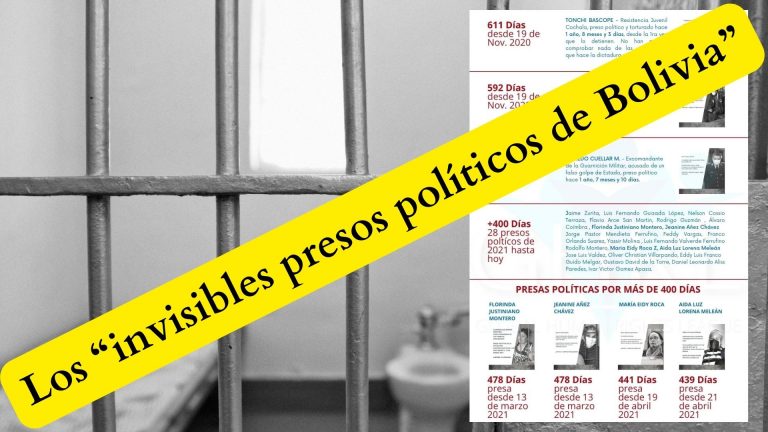
Bolivia is close to reaching a hundred political prisoners: in one year and seven months, the dictatorship has accumulated 90 political prisoners, two of whom have died in prison, without medical attention and showing signs of torture.
Of all of them, 10 are women, ranging from indigenous civic leader Florinda Justiniano —who dared to take down a flag of the ruling party, the Movement Toward Socialism (MAS), increasingly recognized as a criminal organization— to constitutional former president Jeanine Áñez, who under constitutional mandate assumed the presidency in 2019 after a massive fraud committed by dictator Evo Morales Ayma.
The disadvantage Bolivia faces compared to other dictatorships is that, although Bolivia is already discussed internationally as a dictatorship in forums, panels, and events, this is still not enough, when within the country some politicians, even while calling themselves "opposition," are afraid to acknowledge this symptom that is leading Bolivia, in the short term, toward the worst persecution of opposition figures in its history.
Elvira Parra, imprisoned for more than 2,650 days (7 years and 3 months), suffers from cancer and fears ending up like her fellow inmate Marco Antonio Aramayo, who died after more than 7 years in prison, accused of corruption when it was he himself who denounced the acts of corruption committed by leaders and government officials very close to dictator Evo Morales.
Under the administration of dictator Luis Arce Catacora, the first political prisoner is Mario Bascopé, of the Cochala Youth Resistance, who has been imprisoned for 611 days. He is being held after being kidnapped, beaten, and moved from one prison to another to cut him off from his family; he has suffered serious medical problems, and so far the only charges brought against him are ones that not even the dictatorship itself has been able to justify.
Next is Marce Rivas, held for 592 days. He was director of Migration and, like all political prisoners, remains under indefinite pretrial detention.
The first member of the military imprisoned by the MAS dictatorship is former commander Alfredo Cuéllar, who has been held for 587 days. It should be recalled that the dictatorship has pressured military personnel to submit to abbreviated proceedings, incriminating themselves in a completely unconstitutional practice that some have allowed themselves to be dragged into, believing the dictatorship will honor the deal of releasing them sooner.
As shown by the organization Global Human Rights League, as of July 4 there are 28 political prisoners held for more than 400 days, among them former president Jeanine Áñez, with 478 days, and former Minister of Health María Eidy Roca, under house arrest for 441 days, for having touched on some of these cases.
Another 14 political prisoners have been imprisoned between 365 and 400 days.
The only way to stop these human rights violations against opposition figures is for Bolivians themselves to make the dictatorship visible. As long as this grave problem within Bolivia is not spoken about loudly and clearly, it will be much harder to help political prisoners, Eva Sara Landau of Global Human Rights League told us.
Bolivia is a dictatorship and must be treated as such, without the considerations that might be extended to a democratic government, if what is truly wanted is to stop the persecution, imprisonment, and exile of opposition voices.