
May 1, 2022
Political Prisoners of Bolivia's Dictatorship Held Under Indefinite Pretrial Detention
Source: Cabildeo Digital
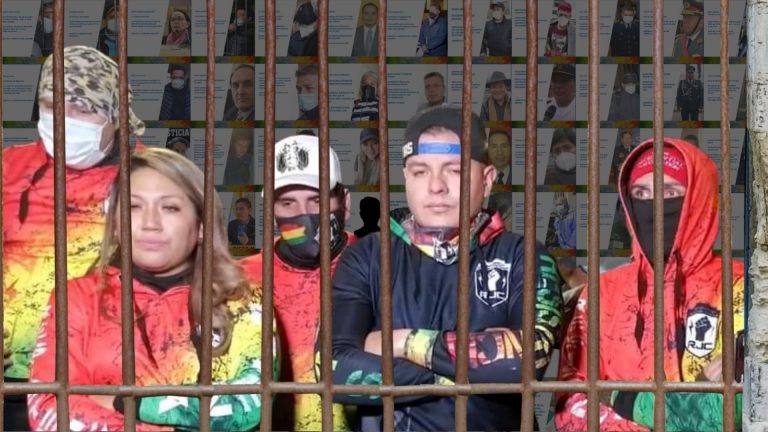
Jorge Valda is a lawyer for the Cochala Youth Resistance
They were the protagonists of the resistance to the electoral fraud and to the MAS shock groups that sought to take over the city of Cochabamba. In retaliation, Nelson Cox unleashed a campaign of persecution against them. In 2019, Cox was the "defender" who protected MAS's violent groups. This government appointed him deputy minister of Government, a position and power he used to cause suffering to five young men from Cochabamba falsely accused of belonging to an "irregular organization." Cox did not last long in that post—he was removed—but he left behind many broken bones and shed tears.
"They are political prisoners, held under indefinite pretrial detention, who suffered physical and psychological torture," says Jorge Valda, defense attorney for Mario and Fabio Bascopé, Milena Soto, Yassir Molina, and Jaime Maldonado.
Cabildeo Digital spoke with Jorge Valda to delve into one of the darkest chapters of Bolivian (in)justice.
— What situation are the detainees of the Cochala Youth Resistance (RJC) in?
— First, the name has been widely stigmatized; it has been used as a synonym for a parastatal group or a paramilitary group, as former deputy minister Nelson Cox once claimed. They have been treated as if they were a group of insurgents seeking to alter the constitutional order in Bolivia, which was not the case.
The Cochala Youth Resistance is made up of young men and women from different neighborhoods and different social classes in Cochabamba who, in 2019, sought to defend themselves from the abuses of the violent groups that the MAS deployed not only in the city but also in its surroundings and, above all, in rural areas.
The Cochala Youth Resistance had that initiative to resist the acts of violence carried out by the Movement Toward Socialism. Yassir Molina and Mario Bascopé took the lead of the peaceful resistance without engaging in criminal acts, sedition, or terrorism, as they were at some point accused of.
— Several members of the Cochala Youth Resistance were detained. Where and under what circumstances is Mario Bascopé being held?
— Mario Bascopé has been detained since December 24, 2020. That same Christmas, the year Luis Arce took office as president, the police entered his home and dragged him out violently; he was missing for nearly 24 hours, and no one knew where he was or what had happened to him.
This was so strange because the fabricated accusation had nothing to do with the events of 2019, the alleged coup, or the fraud, but instead with a case from 2017, in which a vehicle was found transporting 2 kg of controlled substances.
The driver was not detained for even a single day. But the case was used against Mario Bascopé because the vehicle had been imported by his company, which was engaged in buying and selling cars, and this occurred in 2015.
That year, the car entered Bolivia and Mario Bascopé sold it; a transfer was made, and the new owner allegedly used it to transport 2 kg of marijuana, cocaine, or whatever it was. That person was never detained, and nothing more was ever learned about that driver.
Based on this case, simply because his name—Mario Bascopé's—appeared as the vehicle's importer, he was arrested on Christmas 2020, and months later was given a 10-year sentence.
He was also included in the case initiated against the leaders of the Cochala Youth Resistance in Sucre, because they demanded the resignation of Juan Lanchipa, the State Prosecutor General.
— What happened?
— I must remind those who may not have this fresh in their memory that the national civic movement, made up of the nine civic committees, called for the resignation of the Prosecutor General, Mr. Juan Lanchipa, due to the illegality of his appointment, which he obtained through fraud.
There were platforms from all nine departments, citizen movements, civic movements, and it was the Cochala Youth Resistance—this citizen movement—that probably made its presence most heard, because they used firecrackers; they were young people making an absolutely legitimate noise, because the national civic movement was present there.
I was there in Sucre; all the civic presidents were there, and we all saw that not a single window was broken, and no one was harmed.
— So what are they accused of?
— They are accused of belonging to a criminal organization, and of possessing unconventional weapons. That is, for using metal tubes to launch firecrackers higher so they would sound louder.
Those are not conventional weapons; they are firecrackers, the same kind used at any soccer match. But they are the ones detained.
Mario Bascopé faces two cases. In the Santa Cruz case, he was sentenced to 10 years without having any involvement whatsoever. The Ministry of Government, with Nelson Cox acting as an agent of political revenge, ensured that this sentence would be a conviction. It is now under appeal.
— Was Bascopé's brother also detained?
— Mario Antonio "Tonchi" Bascopé is detained in the San Roque prison (Sucre), and his brother, Fabio Bascopé, who was detained a few months after Mario, is also held there.
He was pursued relentlessly. He first went into hiding, then sought asylum and took refuge with the Pro Santa Cruz Civic Committee, and later went to Cochabamba, where he was captured. He was taken to Sucre and remains detained to this day. Both have children, both are heads of household, and were the breadwinners of their families.
But Tonchi's case is much more complicated because he has five children, one boy and four girls. His wife is in tears, demanding her husband's return home. His youngest child is a two-year-old baby; his older daughters are 20, 17, and 15 years old.
They have told us how they suffered bullying at school or university: "your dad is a thug, your dad organized the Cochala Resistance."
That comes from die-hard MAS supporters, who are not all of them, because there are also those who defend them as heroes and recognize them as people who fought authentically for Cochabamba.
— What is Yassir Molina's situation?
— He has been through four prisons. Yassir Molina is probably one of the youngest leaders of the Cochala Youth Resistance; he graduated from the San Simón University Law School and is due to take his final bar exam, but he has not been allowed to leave prison to take it.
Yassir was first detained in San Sebastián, Cochabamba, then transferred to the San Roque prison in Sucre, where Tonchi is held; then to Cantumarca, Potosí, where Marco Pumari, the former Potosí civic leader, is held; and now he is in the San Pedro prison in Oruro.
He is held in a special section, apart from the rest of the inmates. He has no children; he has a person he calls his mother, Daniela Hidalgo, who has also been summoned and prosecuted simply for being Yassir's adoptive mother.
Molina, at this moment, is the one most eager to make his voice heard, due to his drive as a new lawyer and the indignation he feels, like any other Bolivian, at seeing so much injustice.
He has no other Resistance members near him, but he has managed to build a solid group of trusted friends in Oruro. He is held in high regard, because I have seen how he has worked with his own hands to help repair various parts of the prisons he has been held in—San Sebastián in Cochabamba, San Roque in Chuquisaca, Cantumarca in Potosí, and now San Pedro—and inmates nationwide hold him in great esteem.
— What about Milena Soto?
— Although Mario, Fabio, and Yassir are the only three under pretrial detention, the suffering is no less for Milena Soto, who has also been tortured, just like Mario Bascopé, who was left for 10 days in a hospital when he was transferred from Santa Cruz to Sucre.
When they tried to detain Milena Soto, she was tortured; she was forcibly taken to the city of Sucre for precautionary measures and was later placed under house arrest, which is not far removed from pretrial detention; it is not very different when you cannot work and cannot provide daily sustenance for your child.
As the mother of a nearly 13-year-old son, she naturally needs all the support her mother can provide; she is detained and is not even allowed the right to work.
— What is Jaime Maldonado's situation?
— Jaime Maldonado, the fifth member of the Cochala Resistance, has been implicated in the Sucre case; he is also under precautionary measures. He is probably the one who has had the chance to continue an almost routine life, but obviously without losing sight of the fact that the trial is about to begin.
This is another of the trials of infamy and shame taking place in the city of Sucre, meant to convict young people who have asked for freedom and justice, for the sole act of making their voices heard in Sucre, without having committed any crime.
— Do these detainees have the support of their families?
— They all have families who support them. In Tonchi's case, many of his relatives live in the U.S.; his mother has been able to visit him a couple of times. But he has family in Cochabamba helping raise his children. He suffers the anguish and helplessness of not being able to be with his older daughters or near his youngest son.
Tonchi is the one who causes the most anguish, as does Fabio, for not being near their children. Even though they are in the same prison, Fabio and Mario Bascopé, despite being brothers, are not even allowed to speak to each other, to be together, or to be in the same section.
Each one is in a different section and cannot even share a lunch or breakfast; this is a merciless act, a form of psychological torture inflicted on the brothers.
All of them have parents hoping to see their children free once again.
— What other human rights violations have you identified in this case?
— When the extension of pretrial detention was ordered, according to one of the essential reforms, the judge was required to set a time limit for the deprivation of liberty; but in this case, the judge directly ruled that "they will be detained indefinitely," because we do not know how long the trial will last, nor whether they will be able to prove their innocence.
They have been presumed guilty; they should have the right to be tried within the framework of due process. However, all of them—Yassir Molina, Mario Bascopé, and Milena Soto—have been tortured; I am speaking of physical torture.
The most appalling case has been that of Mario Bascopé, who, after being transferred from Santa Cruz to Sucre, ended up spending 10 days in a hospital where they did not even allow his wife to approach to see how her husband was. Why? Because she could not be allowed to see him unconscious and covered in bruises from the beating he had received.
These events have been documented in the complaint filed with international bodies, such as the United Nations, but to date no justice has been applied; they are being denied the right to health. When he manages to call me, he tells me he receives no specialized medical care, and no matter how much we request doctors, the Penitentiary Directorate does not respond.
That is outrageous, because his life is in danger, his health is at risk, and it cannot be that the requests of political prisoners today are simply ignored.
— What is the legal situation? Is a final trial expected?
— Although more than a dozen cases have been opened against them in Cochabamba and across the country, the case and trial initiated by the State Prosecutor General's Office, with Prosecutor General Juan Lanchipa as the alleged victim, is the one for which all of them are held in pretrial detention, with not the slightest intention on the part of any judge or court to order their release.
There has been an accusation without them even knowing why they are being accused. There is already a trial date that has not yet been notified to them. Next month, we are certain, this new trial of shame will begin, in which Lanchipa bases his accusation on a lie: that the Cochala Resistance was a parastatal organization or an irregular group, when in reality the only irregular groups that exist are the 76 armed militias that Mr. Evo Morales has established in Bolivia.
— Who is Jorge Valda, and why does he defend the Cochala Youth Resistance?
— Jorge Valda is a lawyer who firmly believes that justice must change.
When, in 2019, we filed actions against Juan Lanchipa, against the departmental prosecutors of the country, and against members of the Supreme Court of Justice, we went to Sucre with my team of lawyers to demand Juan Lanchipa's resignation.
At that time, in 2020, we had already formed a strong alliance with the Pro Santa Cruz Committee, with the National Civic Movement, with platforms, and with the leaders of citizen movements, such as the young people of the Cochala Youth Resistance, to whom we promised not to leave them alone and to fight day by day for a different kind of justice.
I knew Mario Bascopé, Fabio, Milena, and Yassir long before these cases began, and I am certain of—and can attest to—the integrity and suitability of each of them, as well as of other leaders who are now detained, such as Marco Antonio Pumari in Potosí and former president Jeanine Áñez, who are now detained for fighting for justice.
We made a promise, back then, that we would not leave them alone, and that promise has extended not only to the young people of the Cochala Youth Resistance but to all political prisoners. That is why this work we carry out as human rights defenders has made us members of the Permanent Assembly of Human Rights alongside Amparo Carvajal, has made us members and ambassadors in Bolivia of Global Human Rights League, a foundation in the United States from which we likewise receive no profit and from which we charge no fees to any political prisoner we have defended.
We have been named human rights defenders by various institutions, and we have now received a membership from Amnesty International to also be part of the fight for human rights.
We do not carry out this struggle alone; thank God there is an army of lawyers in Bolivia willing to work and contribute to the defense of human rights.
We have the trust of those who managed to regain their freedom, who are very few, such as Florinda Justiniano in Montero, civic leader Catiun Müller in Riberalta, or Felipe Hermosa in Villamontes; they have managed to return home.
They are three out of 85; the rest are still waiting for the joy of returning home.
From Cabildeo Digital